For newly built renewable energy assets, renewable energy trading becomes mandatory at a peak capacity of just 100 kilowatts. But what options do plant operators actually have, and what are the advantages and disadvantages of the market premium model, PPAs, and non-subsidized renewable energy trading?

How does renewable energy trading work?
At a glance
- Renewable energy trading means power is actively sold on the market instead of being remunerated at a flat feed-in tariff. It's mandatory for new renewable assets from 100 kW onward.
- The central model is the market premium model (feed-in-tariff-supported trading): operators sell their power on the market and receive the market premium on top.
- Alongside this, non-subsidized renewable energy trading (without EEG support), PPAs, and ancillary services offer additional routes to market, each with a different risk-return profile.
- Renewable energy traders today take on central market roles — power trading, balancing group management, and dispatch responsibility — making them a core operational building block of Redispatch 2.0.
Definition: What is renewable energy trading?
Renewable energy trading means that power isn't remunerated through a flat feed-in tariff, but actively sold on the market. In the early years, operators of wind, solar, and biomass plants typically collected a fixed feed-in tariff per kilowatt-hour; today, renewable energy trading is the standard for larger generation assets.
The power is typically sold on the spot market (e.g., the day-ahead or intraday market) or the futures market of the power exchange, or via bilateral contracts (over-the-counter, or OTC). Many investors outsource trading to external renewable energy traders and focus instead on developing and operating their assets.
What are the benefits of renewable energy trading?
Renewable energy trading strengthens the market and system integration of renewable energy through genuine price signals. Given suitable grid and market conditions, this holds especially true when compared with flat feed-in tariffs.
- On the market side, this mechanism sends producers clear price signals reflecting supply and demand. Because power sometimes trades at very low or even negative exchange prices, overproduction is penalized by the market, while scarcity is rewarded through high prices. On the flip side, this creates an incentive to make consumption more flexible and shift demand toward periods of high wind and solar supply. The more market participants respond to these signals, the more price extremes are dampened.
- At the system level, this has two main effects: first, the generation potential of wind and solar assets is used more fully, reducing the need for expensive power from fossil generation. Second, the grid is less frequently overloaded by a surplus of renewable power. As a result, generation assets need to be curtailed less often, which in turn lowers compensation payments (redispatch costs).
For these reasons, Section 21 of the German Renewable Energy Sources Act (EEG) requires that renewable power from wind and solar assets with a peak capacity of 100 kilowatts (kWp) or more — with a few exceptions — be sold via renewable energy trading. Flat feed-in tariffs are, in practice, only still available for assets of this size that were commissioned before 2016. For biogas plants, the trading obligation has already been in place for two years longer.
That said, operators of older assets are increasingly switching to renewable energy trading as well — whether because their feed-in tariff, capped at 20 years, has expired, or because trading simply looks more lucrative to them.
The phased introduction of zero remuneration since 2023 (the suspension of the market premium during negative power prices) has reinforced this shift. Because the marginal cost of renewable power is close to zero, producers have a strong incentive to keep feeding in power even when the market is oversupplied, as long as they're compensated for it. At times of grid congestion, this could result in double costs — for curtailment (negative balancing energy) and for remuneration.
Who handles renewable energy trading?
In practice, renewable energy trading is usually handled by specialized power trading companies. Only large energy groups maintain their own in-house departments or dedicated subsidiaries for this. Smaller operators — whether running entire solar and wind farms or individual generation assets — hand this responsibility over to professional traders.
These are power trading houses, large and small, with in-depth knowledge of the power market's opportunities, risks, and sometimes highly granular regulations. The renewable energy trader handles not only sales and settlement, but also the system-critical market roles of Balance Responsible Party (BRP) and dispatch-responsible party (EIV).
For the plant operator, the renewable energy trader is typically the sole point of contact and business partner on the sales side. Together, they agree on a trading model and a remuneration model. Exactly how the power is ultimately brought to market, however, is up to the trader alone — whether they act purely as a trader on the power exchange, or also as an independent supplier to end consumers.
We are your trader and risk manager for renewables and flex assets
Our trading experience and forecasting technology allow us to manage large renewable and flex portfolios at competitive prices.
What marketing models exist in renewable energy trading?
Renewable energy trading offers several marketing and revenue models, each with a distinct risk-return profile. The most important are:
- The market premium model, also known as feed-in-tariff-supported trading, is the central pillar of Germany's EEG-based support scheme for the energy sector.
- Non-subsidized renewable energy trading uses similar mechanisms but is subject to fewer requirements.
- PPAs, as long-term contracts, can provide a high degree of planning certainty.
- Ancillary services create additional revenue opportunities and increase the importance of renewable energy trading for power supply.
Marketing model | Advantages | Disadvantages |
|---|---|---|
Subsidized renewable energy trading | Financial safety net through support during periods of low power prices | Extensive requirements |
Non-subsidized renewable energy trading | Fewer requirements | Risk hedging must be fully self-managed |
PPA (Power Purchase Agreement) | Fewer requirements | Customized risk adjustment can be costly |
Ancillary services | Flexible, supplementary revenue source | Very high technical requirements for the asset |
What is the market premium model?
The market premium model is the central instrument of feed-in-tariff-supported trading under EEG. By now, it applies to most larger EEG-supported assets, regardless of technology. Instead of receiving a fixed feed-in tariff per kilowatt-hour, operators — or their renewable energy traders — sell the power on the market. As EEG support, they then receive a market premium from the responsible grid operator for every kilowatt-hour fed in.
The market premium is the delta between an asset's individual strike price and the monthly reference market value (RMV). The lower market prices are in a given month, the higher the market premium climbs, and vice versa. If the reference price is higher than the asset's own strike price, the market premium drops to zero. In other words: even if the gap between the strike price and the market price turns negative, no negative premium is calculated — instead, "zero support" applies.
Through this mechanism, the market premium makes it easier to operate renewable energy assets profitably in Germany, while still preserving the incentive to achieve high market prices. Thanks to intense competition, this brings a broader economic benefit: average power prices fall. The reasoning is straightforward — the more suppliers feed power (including from storage) into the grid during price peaks, the lower those peaks ultimately turn out to be.
How is the market premium calculated?
Applicable value − reference market value = market premium
The reference market value (RMV) is a figure defined under Annex 1 of the EEG. It reflects the average monthly price that an asset with a standardized feed-in profile would have achieved on the spot market — in other words, a volume-weighted average price. Separate reference market values are determined for solar PV, onshore wind, and offshore wind. For all other EEG-eligible generation types (e.g., biomass, geothermal, and hydropower), the average spot market price across all energy sources applies. The RMV is published by the transmission system operators after the end of each month and is used exclusively to calculate the market premium as defined under the EEG.
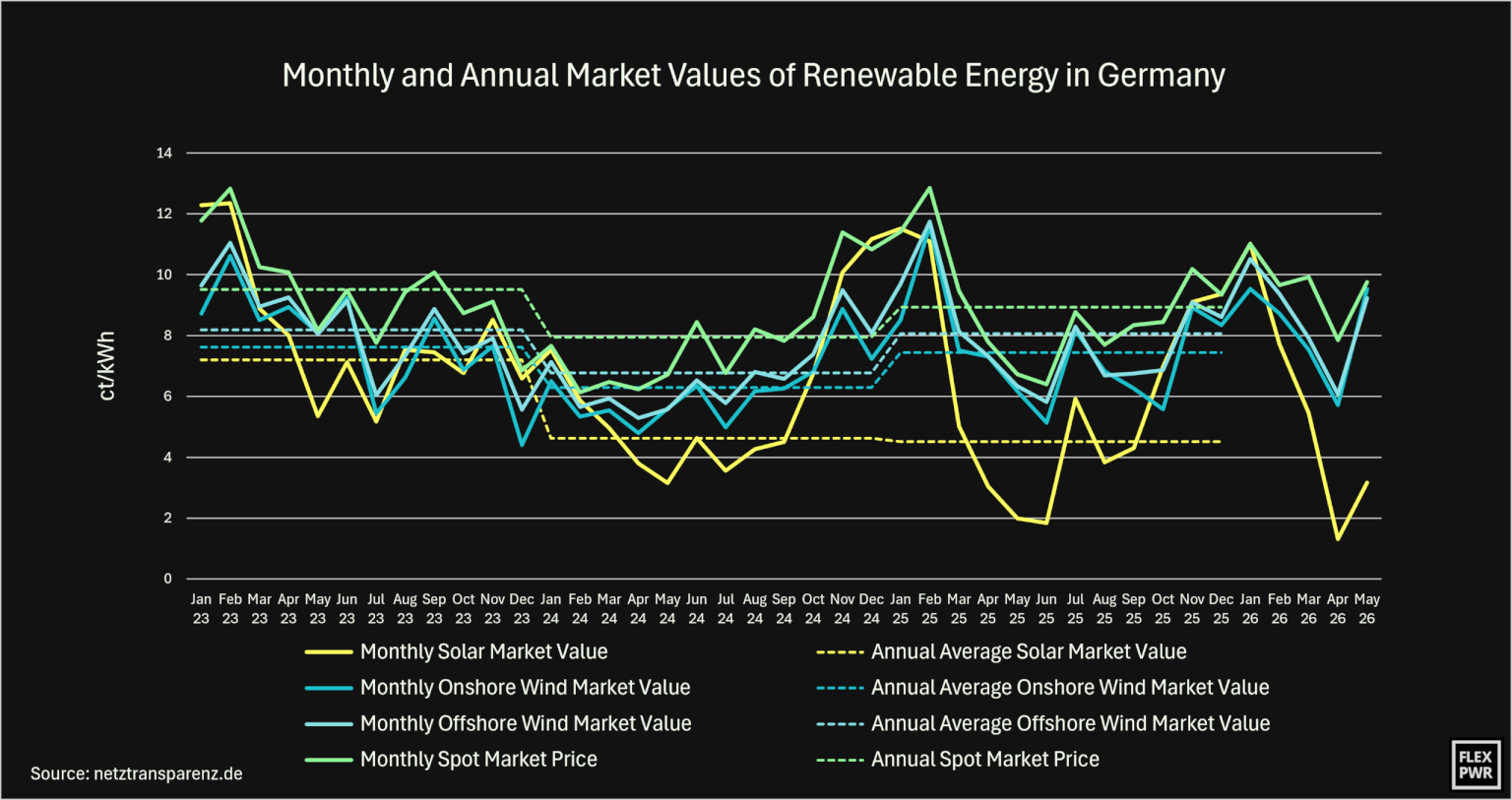
Power prices are lower in summer, an effect that is especially pronounced for solar PV. Here, the higher price partially compensates producers for the lower production volumes.
Unlike the RMV, the strike price (AW) is asset-specific. These days, it's typically determined through reverse auctions as part of government support tenders. In these auctions, plant operators submit bids, which are awarded starting from the lowest until all available capacity is allocated. To improve their chances of winning, operators tend to bid the lowest strike price (in ct/kWh) at which they're willing to commission an asset. In other words, they don't bid the price they actually expect to realize — they've already factored the market premium into their calculation.
The market premium model gives weaker sites a relative advantage ex ante, since they need to bid higher to operate profitably. If awarded a contract, they then receive — per the formula — a somewhat higher market premium than assets at stronger sites that bid lower.
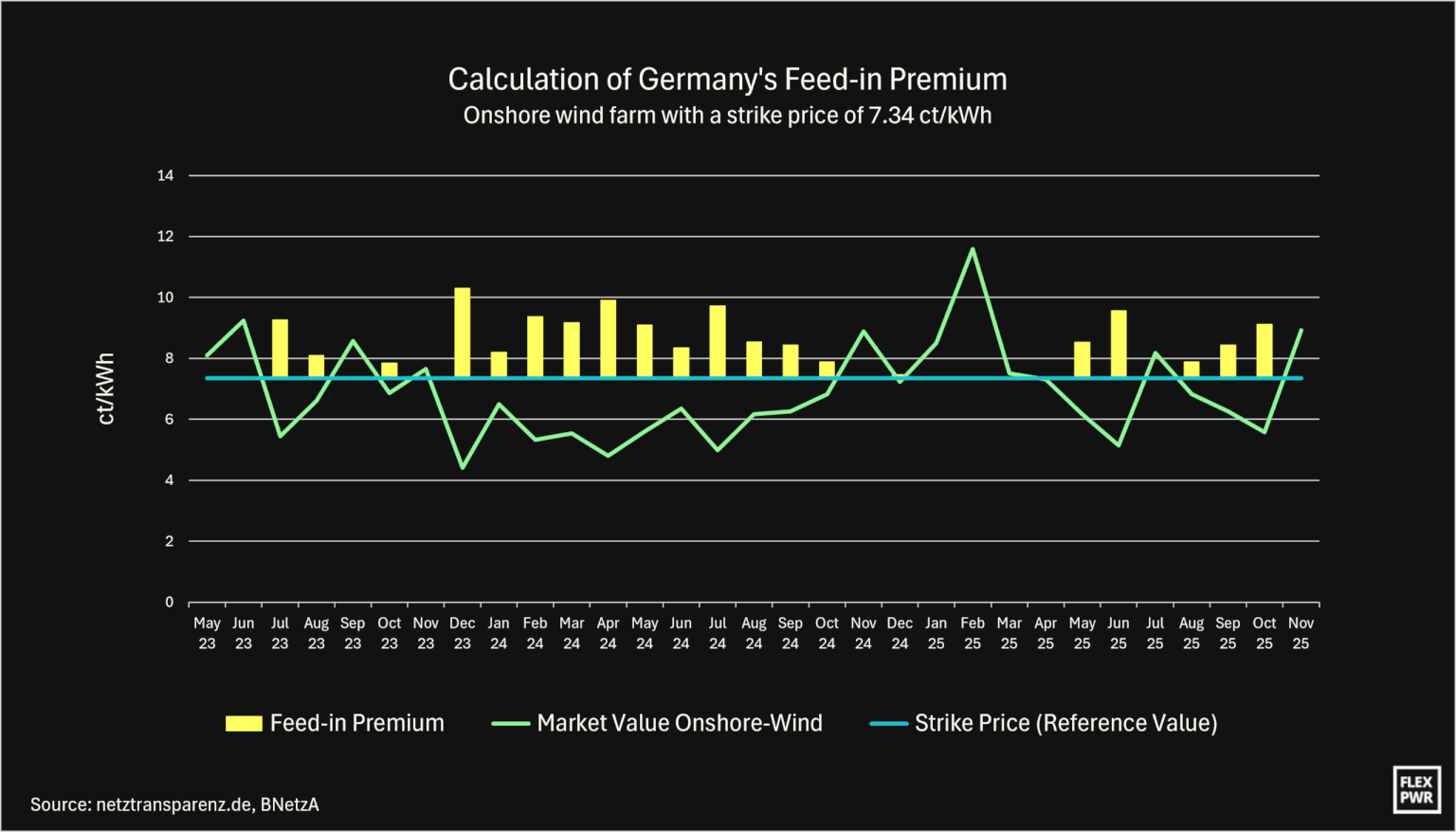
In the onshore wind tender of February 2023, for EEG support starting May 2023, the average applicable value bid was 7.34 ct/kWh. For an asset with this strike price, the market premiums shown here were paid out between May 2023 and December 2025.
Example: Calculating total revenue with the market premium
An asset's exact revenue depends primarily on actual weather conditions, which determine the timing and volume of power production. Power demand and the trader's skill also play a role.
To sketch out how the market premium works in practice, let's look at an onshore wind asset that won a contract in the February 2023 EEG tender with a strike price of 7.34 ct/kWh — the average bid in that auction. The corresponding market premium (see the previous chart) applied from May 2023 onward.
For this example, we'll assume that the renewable energy trader achieved exactly the average price of all onshore wind assets over the period in question — in other words, the technology-specific reference market value. This gives us:
Total revenue per kilowatt-hour = market price achieved + market premium.
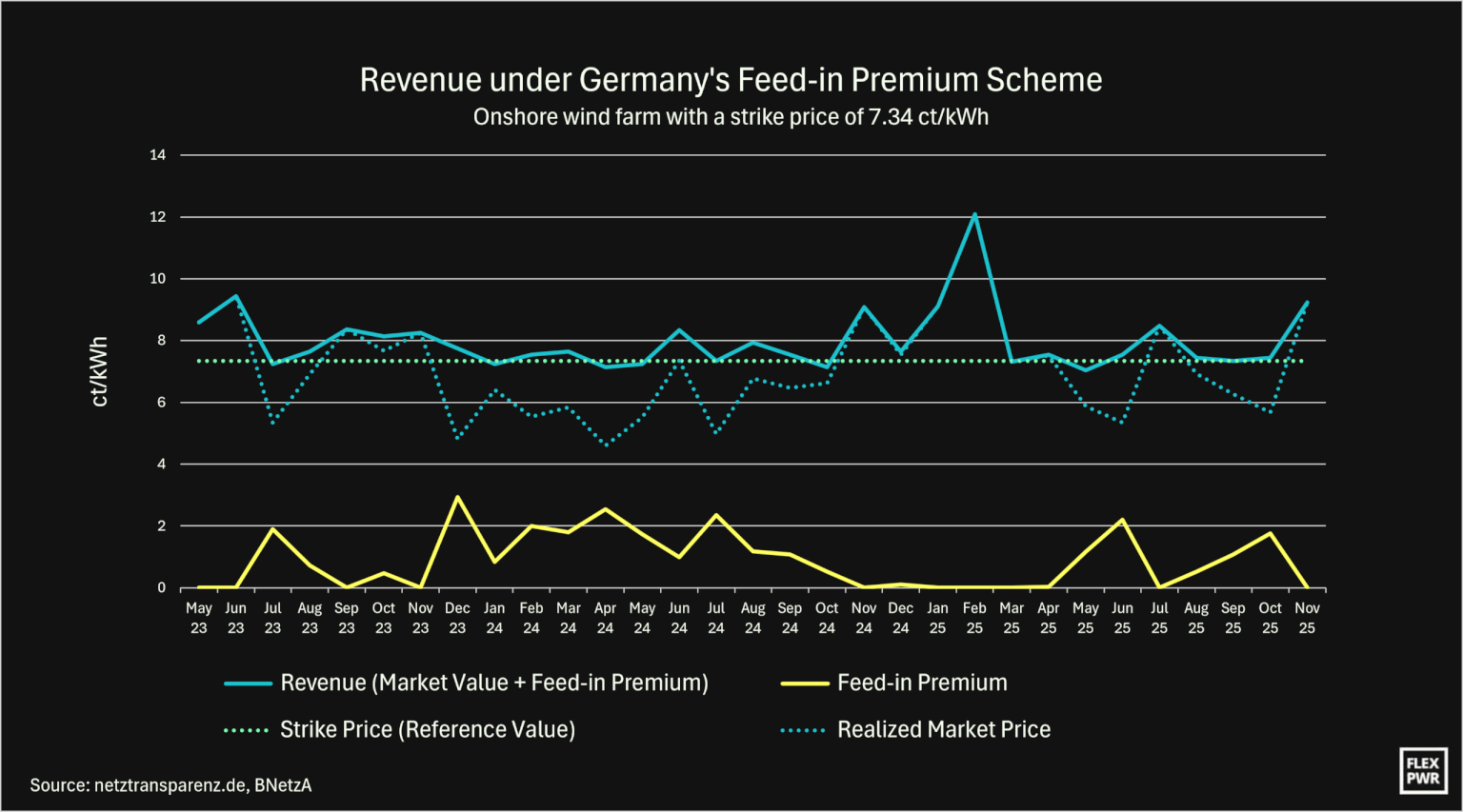
The market premium supports plant operators' revenues especially during periods when market prices are low.
What does "non-subsidized renewable energy trading" mean?
Non-subsidized renewable energy trading refers to selling power without drawing on EEG support. Revenue then depends entirely on the market price, or on individually negotiated supply contracts.
This model is used, on one hand, for assets that have reached the end of their support period but can still be operated profitably. On the other hand, it also covers new projects that failed to win a support auction, were never registered for one, or lost their eligibility for the market premium because the asset wasn't commissioned in time. Assets without the technical capability for remote control by the grid operator, as well as projects receiving other forms of support, are excluded from the market premium regardless.
Some operators, however, forgo EEG support voluntarily. This has to do with the double-marketing ban under Section 80 of the EEG, which prohibits issuing a Guarantee of Origin (GoO) for EEG-supported power. GoOs are certificates that let consumers verify the extent to which they're using sustainably produced power. They carry their own market value, independent of the power price, and can generate additional revenue when traded.
In theory, operators of EEG-supported assets can switch from subsidized to non-subsidized trading on a monthly basis. In practice, however, experience shows that this switch carries certain process risks. As a result, many renewable energy traders prefer longer intervals between switching marketing models.
What are power purchase agreements (PPAs)?
PPAs are long-term power supply contracts between plant operators and offtakers. A distinction is made between physical PPAs, where power is actually delivered, and synthetic or virtual PPAs, which function as a hedging instrument (a contract for difference, or CfD). PPAs offer long-term planning certainty but tend to involve complex contract design — pricing formulas, profile risk, default provisions, and creditworthiness requirements. Increasingly, however, standardized products — also known as Liquid PPAs — are entering the market, bringing greater transparency and lower transaction costs.
In principle, power sold via PPAs remains eligible for EEG support. However, this again means no Guarantees of Origin can be issued — something many PPA customers specifically value.
What are ancillary services?
Ancillary services are services required to keep the power system stable and secure. Within renewable energy trading, they've so far played only a supplementary — though increasingly important — role. By providing control reserve or other flexibility services, assets under renewable energy trading can generate additional revenue on top of power sales. This further strengthens the market integration of renewable energy, while giving operators an incentive to design their assets to be controllable, forecastable, and grid-friendly. At the same time, it raises the importance of professional dispatch, forecasting, and balancing group management on the part of renewable energy traders.
What remuneration models exist?
Renewable energy trading commonly offers two remuneration models: remuneration based on the reference market value (RMV), or on the plant-specific market value.
It's important to note that the choice of remuneration model has no bearing on EEG support: the market premium isn't calculated by the renewable energy trader, but by the responsible grid operator, and is paid out directly to the plant operator.
How does remuneration based on the reference market value work?
As we've seen, the reference market value (RMV) is a central concept in the EEG support system. It's determined retrospectively each month by the grid operators, for various generation types. If a plant operator chooses RMV-based remuneration, they receive the corresponding RMV from the renewable energy trader for every kilowatt-hour produced that month.
The trader, meanwhile, sells the power on the market for its own account and seeks to maximize its own revenue. In effect, it assumes the producer's price risk.
This remuneration method offers two key advantages for plant operators:
- Maximum transparency: The plant operator knows exactly how much power was produced. The RMV can be looked up on netztransparenz.de at the start of the following month. A simple multiplication of the two figures gives the operator their monthly revenue.
- Security: RMV-based remuneration acts as a built-in risk buffer (hedge), significantly reducing the plant operator's price risk. Thanks to this indexed remuneration, the operator's revenue depends neither on when their asset produces power, nor on how skillfully their trader operates on the power exchange.
How does remuneration based on the plant-specific market value work?
The plant-specific market value (PMV) is the theoretical market value of a specific asset. Remuneration is calculated from the exchange price in each quarter-hour, multiplied by the volume of power fed in during that interval.
For example: on day X, a wind turbine produced 1,000 kilowatt-hours of power between 12:00 and 12:15 p.m. The day-ahead price for that quarter-hour was 8 ct/kWh. The operator therefore receives remuneration of 80 euros for that quarter-hour.
The PMV thus reflects the actual profitability and trading performance of the specific asset. As with RMV-based remuneration, it makes no difference whether the trader generates revenue on the spot market, the futures market, the power exchange in general, through ancillary services, or in OTC trading.
Compared with RMV-based remuneration, this results in the following trade-offs:
- Moderate transparency: In theory, this remuneration method is also fully transparent, since the plant operator can track both the day-ahead prices (for example via the Bundesnetzagentur) and their asset's quarter-hourly production. In practice, though, the calculation effort is far greater, since 96 separate prices and generation volumes have to be applied for every day.
- Moderate security: With PMV-based remuneration too, the plant operator's revenue doesn't depend on the trader's skill — but it does depend on exactly when, and how much, the asset produces.
- Significant upside: Assets at favorable sites can achieve above-average revenues. Operators can hedge against unfavorable production cycles using instruments such as PPAs or virtual batteries.
What's special about marketing innovation tender projects?
Innovation tenders complement the standard EEG tenders. They target projects that deliver particular systemic value — typically projects that combine different generation types, such as PV and wind power, at the same grid connection point, or that pair renewable assets with large-scale storage, enabling especially grid-friendly feed-in.
In principle, projects from innovation tenders have access to the same marketing and remuneration models as other renewable assets. In the support auctions for innovation tenders, these operators can succeed with higher bids than other EEG assets and, correspondingly, receive higher market premiums.
To qualify for innovation tenders, however, projects must meet additional technical and conceptual requirements. Further restrictions apply during operation. For instance, storage units may not be charged from the grid, since doing so — similar to the situation with PPAs — would introduce grey power into the balancing group and void the project's eligibility for support.
Storage assets, however, have a range of marketing options available to them. In particular, they're well suited to generating so-called arbitrage profits: power can be stored during low-price periods — whether from the asset's own generation or from the grid — and fed back in at a profit during high-price periods. As a result, non-subsidized renewable energy trading often promises higher returns than EEG support, even for combined projects.
Conclusion: renewable energy trading is a core element of Redispatch 2.0
Renewable energy trading plays a central operational role in Redispatch 2.0.
What is Redispatch 2.0?
"Redispatch 2.0" refers to the evolution of the redispatch framework designed to accommodate the growing volume of renewable energy.
"Redispatch" refers to interventions by grid operators to prevent over- or undersupply: power plants are ramped up or down depending on demand, since feed-in and withdrawal must always remain in balance.
The expansion of renewables has created new challenges — not only because of their limited controllability, but also because of regional differences in how power is used. Wind power generated in the Baltic Sea, for example, can in principle be consumed at the very same moment by an industrial plant in Baden-Württemberg. But this only works if transmission capacity is sufficient. Otherwise, wind turbines have to be throttled and a power plant in the southwest ramped up, or power imported from a neighboring country. This process used to be called "feed-in management" (Einspeisemanagement).
Redispatch 2.0 adapted the framework to the demands of decentralized, sometimes involuntarily fluctuating power generation. Since October 2021, renewable energy assets that were previously only curtailed under feed-in management have increasingly been integrated into fully coordinated redispatch processes. This means wind and solar assets can now be run at partial capacity to meet short-term increases in demand as well. With Redispatch 2.0, feed-in management and redispatch are therefore increasingly merging into a single process.
Renewable energy traders are taking on additional market roles
With Redispatch 2.0, renewable energy traders are increasingly taking on responsibilities that were previously handled mainly by power plant operators and grid operators. Today, many renewable energy traders occupy three central market roles in power supply:
- As power traders, renewable energy traders continuously balance supply and demand, fine-tuning the purchase and sale of generation capacity right up until delivery — helping to minimize the overall need for redispatch measures.
- For a large share of EEG and combined heat and power assets, renewable energy traders act as Balance Responsible Parties (BRP). In this role, they're responsible for the generation schedule of the assets.
- As power from renewable generation assets takes on a more active role under Redispatch 2.0, renewable energy traders also take on the role of dispatch-responsible party (EIV), planning and executing redispatch measures.
The work of renewable energy traders today is far more complex than it was in the early days of the energy transition. Where they once mainly served as service providers to wind and solar asset operators, they now carry out functions that are critical to the system as a whole.
From Action to Zuccess
Knowledge is Key
Achieving 100% Renewable Energy is a generational task which requires innovation and knowledge on an unprecedented level. We will get faster to 100% Renewable Energy when we as a generation share as much information as possible with each other. This is what we strive for with our School of Flex.
Flex Index
"How much money can I make with a battery?", we get asked a lot. To answer this question, we created the Flex Index, which is a transparent reference for the value of flexibility on the German power market. Check it out...
Videos & Podcasts
Nothing beats first-hand knowledge from experts. Our energy traders and engineers give insights into their job, the market environment they operate in, and what we are working on.
Speaker wanted?
You are on the hunt for a speaker on topics such as power trading, battery energy storage, or the need to balance renewables?
Ask for a speaker and we will send one of our experts to your lecture or conference.
Do you have it in you to be an energy trader?
Find out by taking the ultimate power trader's quiz and answer questions on energy markets and trading strategies!
Discover our Services
FLEXPOWER helps you to bring your portfolio to the energy market. We combine over 25 years of experience in renewables trading in our seasoned team of short-term energy traders. We manage large-scale renewable portfolios and flexible assets with our lean and fully digitized approach.
Say Hi!
Citadel FlexPower GmbH
Citadel FlexPower GmbH (formerly CFP FlexPower GmbH)
Lippmannstraße 8
22769 Hamburg
Tel: +49 40 60778-6155


© 2026 Citadel FlexPower GmbH
(formerly CFP FlexPower GmbH)